A NEW BOOK BY GURPREET PADDA, MD
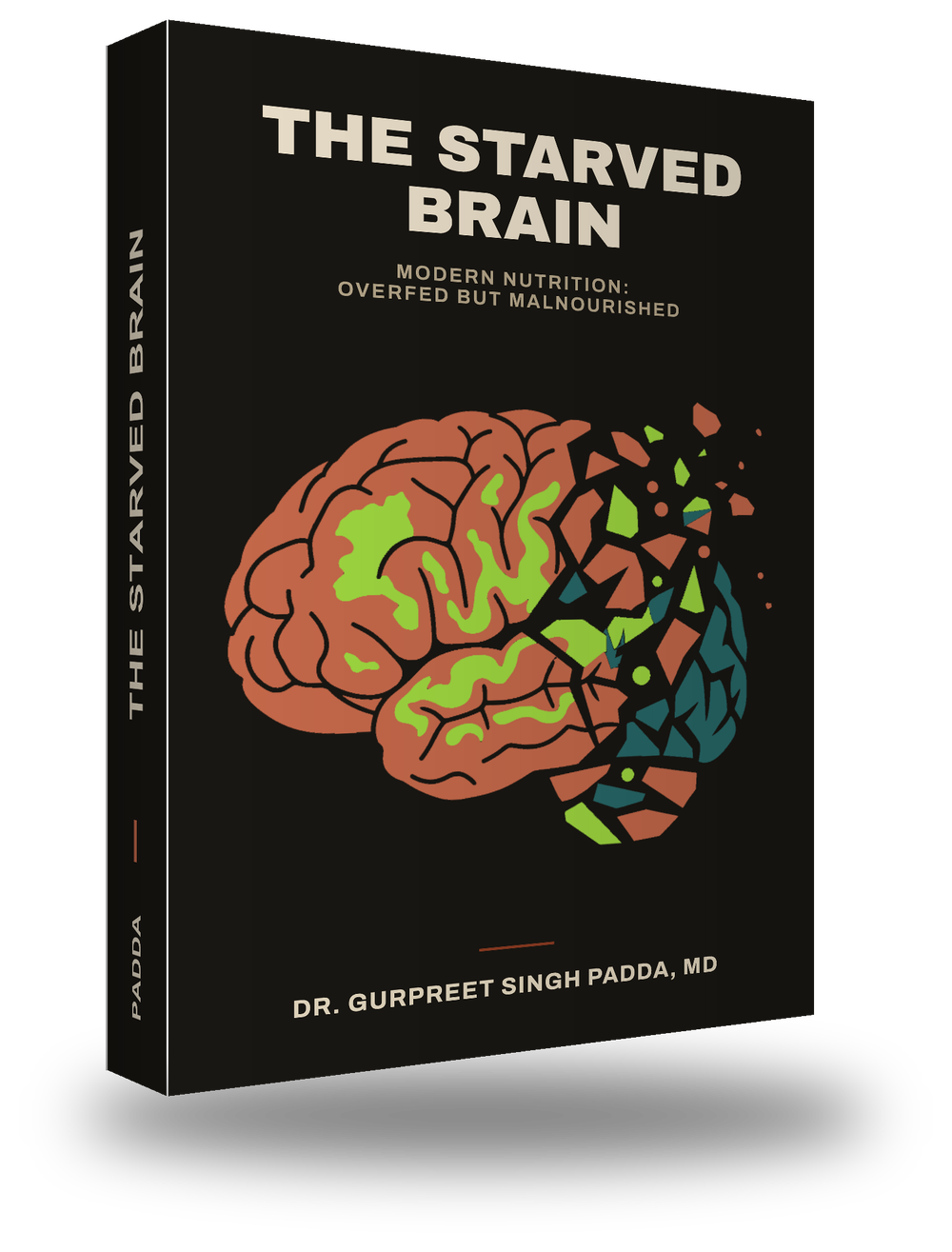
You are not running out of time.
You are running out of fuel.
Most of what we call “normal aging of the brain” isn’t aging at all. It’s what decades of quiet malnutrition look like, written into an organ — in a population that has never missed a meal.
10 chapters · 26 peer-reviewed references · every claim cited
Overfed. And starving.
We have a word for what happens when a body doesn’t get enough food. We picture famine. We picture wasting. We know it when we see it.
We don’t have a good word for what’s happening to most people right now — which is something stranger and much harder to see.
People are consuming more calories than any population in human history while running short of the specific materials their brains are built from. Overfed and undernourished at the same time. Nobody looks starved, so nobody looks.
And the excess isn’t inert. It generates the inflammation, the glycation, and the insulin resistance that damage the very tissue the missing nutrients were supposed to build.
The brain gets hit twice. Starved of what it needs. Damaged by what it gets instead.
This book is about that double injury — what causes it, how it’s measured, and what the evidence actually says about correcting it.
Ten chapters. Every claim referenced.
Built around four pillars of brain terrain — fuel, structure, nutrients, and inflammation.
1 · The Great Paradox Why “normal age-related atrophy” may be the most misleading phrase in medicine.
2 · The Metabolic Inheritance What your brain actually runs on — answered by your own physiology, not a committee.
3 · The Fuel Crisis Why a growing number of researchers call Alzheimer’s “type 3 diabetes.”
4 · The Architecture of Thought Your brain is 2% of your body weight and holds 25% of your cholesterol. That isn’t an accident.
5 · The Canary How a lab result inside the “normal” range can be shrinking your brain — measurably, on a scan.
6 · The First Thousand Days and the Last The same deficiency. Two windows. Two very different catastrophes.
7 · The Fire Within The sugar that switches on an ancient starvation program — and keeps it on.
8 · The Gateway What researchers found in Alzheimer’s brains that started in the mouth.
9 · One Correction, Many Diseases What ketogenic therapy actually does — including where the evidence doesn’t hold up.
10 · The Regenerative Path What to measure, in what order, and why waiting for a diagnosis is waiting too long.
It tells you where the evidence is weak.
There is a great deal of confident nonsense written about brain health. Most of it works by showing you the studies that agree and quietly skipping the ones that don’t.
This book does the opposite, on purpose.
When a widely cited study didn’t reach statistical significance, it says so. When the authors of a paper explain their own findings differently than I do, their explanation is included. When a systematic review contradicts a trial I’d rather cite, both are on the page. One chapter corrects a claim that circulates widely among people arguing the same case I am — because it’s wrong, and being wrong about a mechanism damages an argument that doesn’t need the exaggeration.
A book that only gives you the good news isn’t a book you can trust with your brain.
Every reference is real, verified against the source, and listed at the back so you can read it yourself.
Get your copy.
The complete book. Enter your email and it’s yours.
No obligation. You can unsubscribe with one click, and your email is never sold or shared.
Prefer to watch?
The book began as a five-part video series. Same argument, same evidence, about ninety minutes total.
Part 1 — The Fuel Your Brain Is Begging For
What your brain actually runs on, and what happens when that fuel fails.
Part 2 — Built From Fat
What the brain is physically made of, and what may be blocking the supply.
Part 3 — The Canary
Why “normal” on a lab report can mean something very different for you.
Part 4 — On Fire
The inflammation you can’t feel, and where it comes from.
Part 5 — One Lever, Many Diseases
What the therapeutic evidence shows — and what it doesn’t.
Who wrote this

Gurpreet Padda, MD is a physician specializing in interventional pain and regenerative medicine. His clinical work is built on a single principle: treat the terrain, not the symptom.
Most chronic disease — cognitive decline, chronic pain, and peripheral neuropathy among them — is downstream of metabolic, structural, and inflammatory failures that are measurable and modifiable. He tests what others assume, says plainly where the evidence is strong and where it isn’t, and builds one correction across the whole terrain rather than treating four problems separately.
He practices in St. Louis, Missouri.
If you’re in the St. Louis area
The book will tell you what to measure and why it matters. It can’t tell you what your terrain is doing.
Dr. Padda sees patients in person in St. Louis. A brain-terrain evaluation examines all four pillars from the book — the fuel your brain is running on, the materials it has to build with, the nutrients that determine whether it can repair itself, and the inflammatory load most panels never test for — and builds one personalized plan across all four.
This is an in-person evaluation in the St. Louis metro area. If you’re elsewhere, take the book to your own physician — Chapter 10 lists exactly what to ask for.
In-person consultations · St. Louis, Missouri
Your brain has been rebuilding itself since before you were born.
It will keep trying, for as long as you give it the materials.
THE STARVED BRAIN
How the malnutrition of excess is shrinking the modern mind — and how to reverse it
© Gurpreet Padda, MD
Work with Dr. Padda → regen.md
This book and website are educational. They do not constitute medical advice, do not create a physician-patient relationship, and are not a substitute for evaluation by a qualified clinician. Do not start, stop, or change any medication on the basis of this material. Significant dietary change requires medical supervision if you take medication for diabetes or blood pressure, are pregnant or breastfeeding, or have kidney, liver, gallbladder, or pancreatic disease or a history of disordered eating. Individual results vary.